V2: Custom PCB
Custom PCB around an ESP32 Feather V2, battery powered, over OSC and OOCSI.
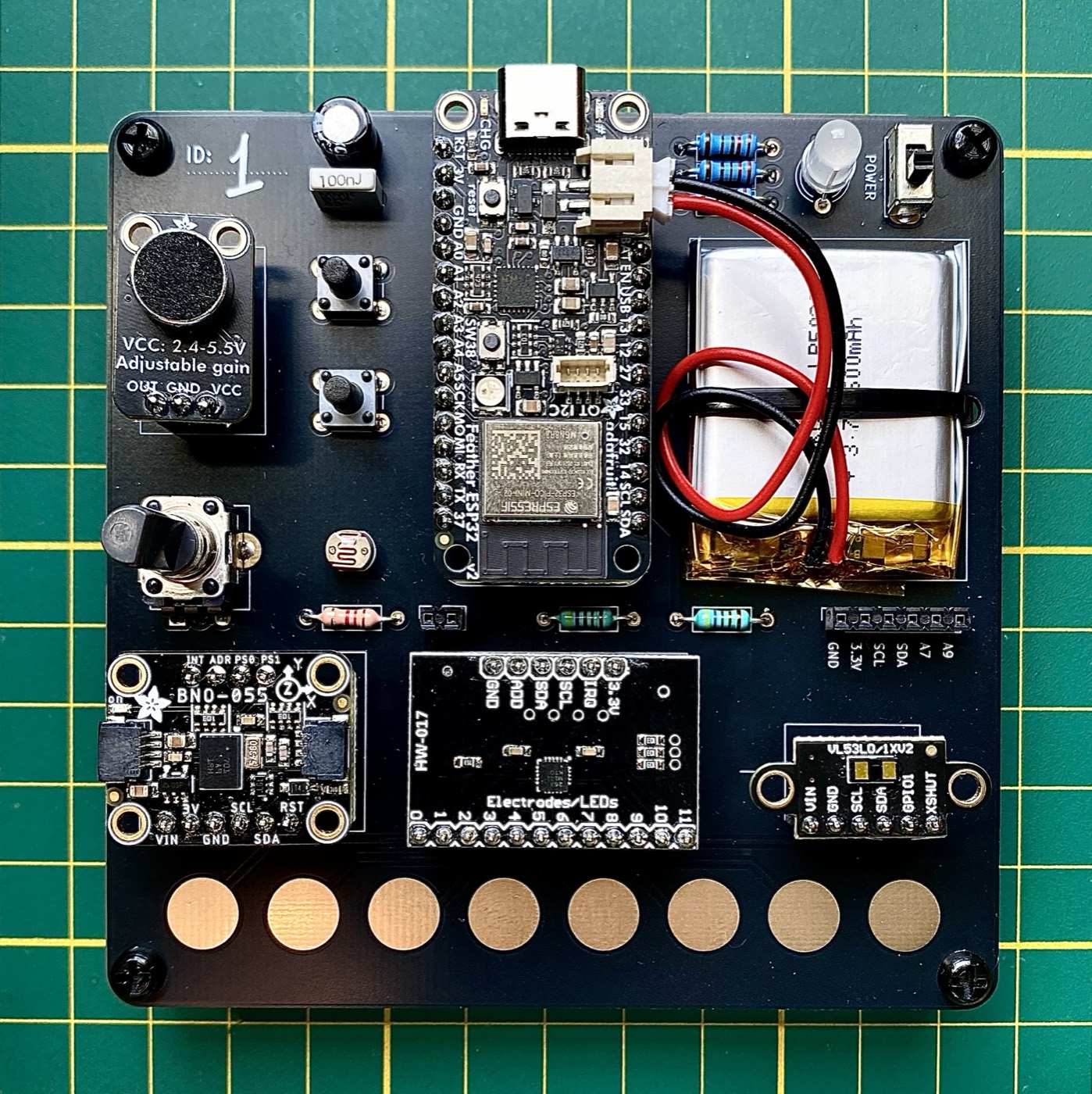
The V1 circuit on a custom PCB, with a battery. Sensor data goes over Wi-Fi to a computer, where Max maps it to sound. Each sensor can be switched on or off and sent over OSC, OOCSI or Serial at its own rate.
Get Started
- Install the Arduino IDE (2.0 or later) and the Espressif ESP32 boards package 3.1.2.
- Install the libraries: Adafruit BNO055, Adafruit VL53L1X, Adafruit MPR121 (1.1.3), OOCSI.
- Copy
secrets.template.htosecrets.hand enter the network credentials. - Set
DEVICE_INDEXinconfig.cppto the number on the board. Each board needs its own. - For OOCSI, uncomment
#define USE_OOCSIinconfig.hand run an OOCSI server. - Upload
arduino/tesito the Feather V2. - Open the Max patches in
max/. They need modulo, modulo+, the Sadam Library, FluCoMa and odot.
Sensors
| Sensor | Variable | Interval |
|---|---|---|
| Battery | BATTERY |
5000 ms |
| Light (LDR) | LDR |
20 ms |
| Microphone | MIC |
30 ms |
| Potentiometer | POT |
10 ms |
| Distance (VL53L1X) | DISTANCE |
20 ms |
| Orientation (BNO055, quaternion) | QUAT |
30 ms |
| Push button | PUSH |
5 ms |
| Capacitive touch (MPR121) | CAP |
5 ms |
| Heartbeat | PING |
1000 ms |
Each sensor is one line in config.cpp: {enabled, osc, serial, oocsi, interval, lastUpdate}. Readings are smoothed (exponential moving average) and sent only when they change.