Mapping
Mapping is the design decision of how one parameter space connects to another — how an input drives an output.
The same input can produce very different results depending on how it is mapped.
Types of Mapping
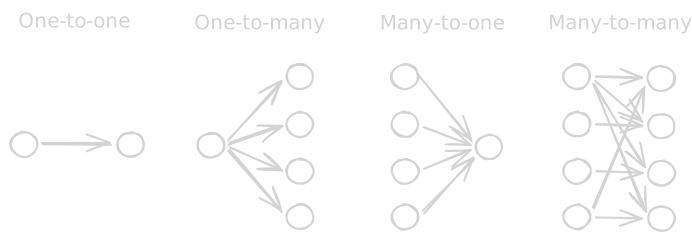
One-to-one — one input → one output. Simple and legible, least expressive.
One-to-many — one input → multiple outputs. More expressive.
Many-to-one — multiple inputs → one output. They combine into a single control.
Many-to-many — multiple inputs → multiple outputs. Hard to predict and control.
Shaping the Signal
How an input value is transformed before it reaches the output.
Calibration — a sensor seldom reaches its theoretical limits. The working range is the minimum and maximum actually observed.
Scaling — an input rarely matches the range of the output (e.g. an audible range of 20 Hz–20 kHz). Scaling maps one range onto the other.
Smoothing — raw input is noisy. Smoothing removes abrupt jumps so the output changes gradually.
Linear vs non-linear — a linear mapping treats every step equally. Because pitch and loudness are perceived closer to logarithmically, a curved mapping can better match their behaviour.
Quantization — snapping a continuous input to discrete steps, such as the notes of a scale.
Direction — a mapping can rise or fall with the input.
Continuous and Triggered
Two basic relationships between input and output.
-
Continuous — direct mapping. The output follows the input.
-
Triggered — nothing happens until a condition is met, at which point an event fires.
Triggers
Ways to refine when a triggered event happens.
Threshold — an event fires when a value crosses a set point.
Hysteresis — a single threshold reacts repeatedly when the input rests near it. Two values, one to trigger and a lower one to release, prevent this.
Hold — the value must stay past the threshold for a set time before it counts, ignoring brief spikes.
Debounce — after an event fires, further triggers are ignored for a short time, removing rapid repeats.
Rate of change — the response depends on how fast a value moves rather than its level. This distinguishes a tap or a shake from a slow movement.
Related
Linked from
- PsychoacousticsPsychoacoustics is the study of how humans perceive sound — the relationship between the physical properties of a sound wave and the subjective experience of hearing it.
- Sound DesignSound design is the practice of creating and shaping sound purposefully for a given context.
- GlossaryKey technical and conceptual terms used in this course.
- Ableton LiveAbleton Live is a digital audio workstation (DAW).
- MaxMax is a visual programming environment for music, audio, and multimedia, developed by Cycling '74.
- PlugdataPlugdata is a free, open source visual programming environment based on Pure Data (Pd).
- SensorsA sensor is a transducer — it converts a physical phenomenon into an electrical signal or digital data that a microcontroller can read.
- Week 6Lecture + Design Workshop2 Jun